

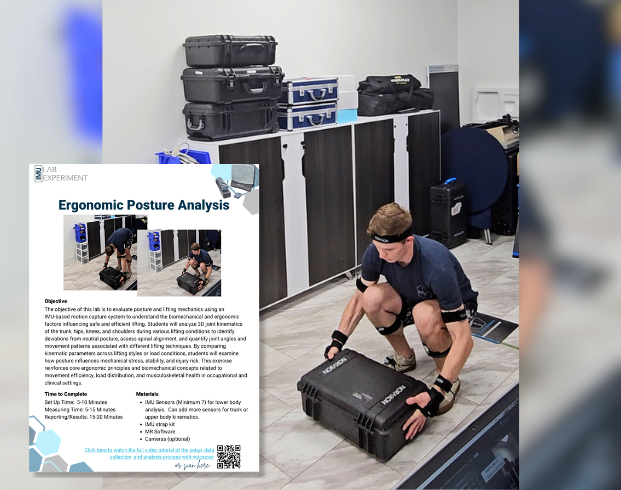
Functional Symmetry In this lab, students will use an IMU-based motion capture system to evaluate posture and lifting mechanics during selected lifting tasks. Students can compare different lifting styles or load conditions to examine how movement strategies change under varying demands. Why Analyze Ergonomic Posture? Analyzing ergonomic posture

At Louisiana State University, undergraduate students are gaining firsthand research experience by using Noraxon technology to study one of the most important topics in human performance: fatigue. Led by Dr. Xavier Thompson, Assistant Professor of Sports Science in the School of Kinesiology, students are participating in an ongoing research project examining how individuals respond
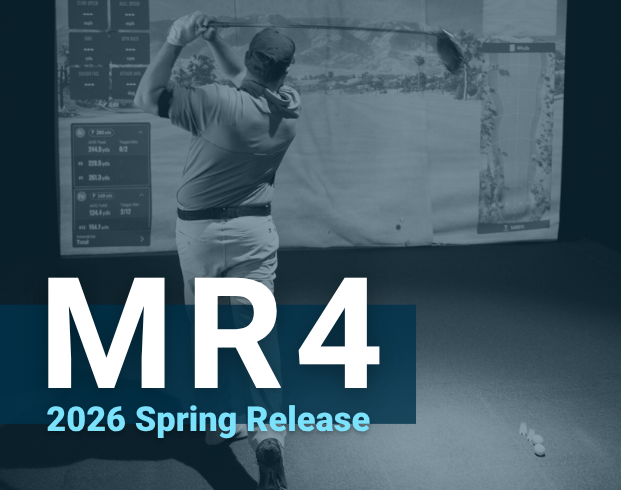
The Spring 2026 Release introduces new analysis tools, expanded motion capture integrations, and workflow enhancements across MR4. This update adds application-specific capabilities such as 4-sensor golf swing analysis, expanded horizontal jump and cutting assessments, and MANUS glove integration for detailed hand and finger motion capture. Beginning with this release, MR4 version numbers will
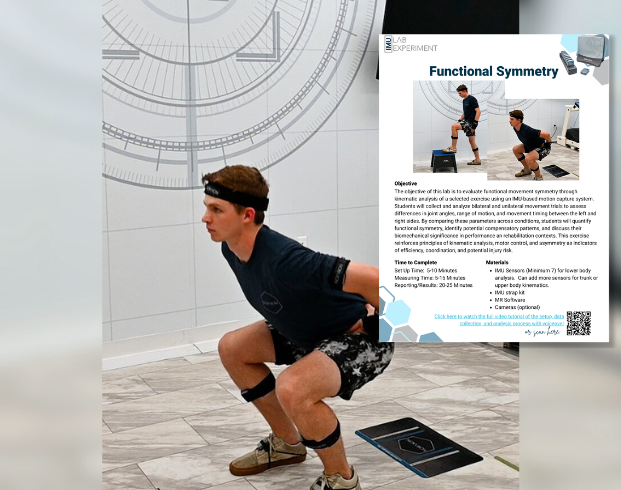
Functional Symmetry In this lab, students will use an IMU-based motion capture system to evaluate functional movement symmetry during a selected exercise. Students can record both bilateral and unilateral trials and compare movement patterns between the left and right sides. Using 3D kinematic data, students will examine joint angles, range of motion, and

Noraxon in the Classroom: Empowering Student Researchers at the University of Tulsa with Dr. Kollock
Dr. Kollock, professor at the University of Tulsa, incorporates state-of-the-art instrumentation into the exercise and sports science curriculum to advance student preparation for professional roles in the movement sciences. By engaging with Noraxon’s technology, students develop applied competencies in kinesiological assessment methods and strengthen their capacity for evidence-based practice. Integrating Noraxon Technology into
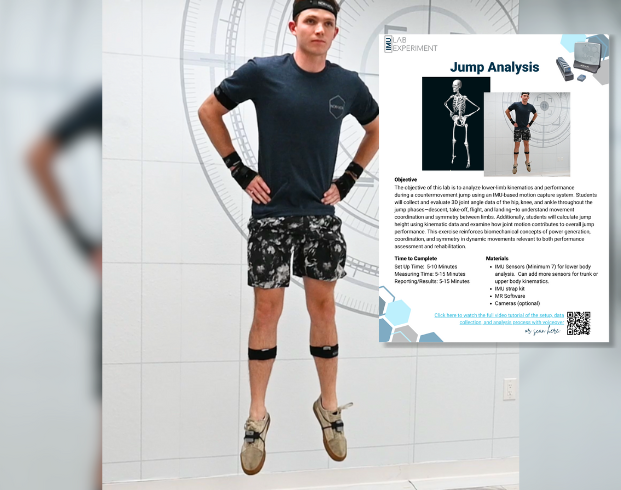
Jump Analysis In this lab, students will use an IMU-based motion capture system to measure and analyze lower-limb movement during a countermovement jump. Students will collect and evaluate 3D joint angle data of the hip, knee, and ankle throughout the jump phases: descent, take-off, flight, and landing; to understand movement coordination and symmetry
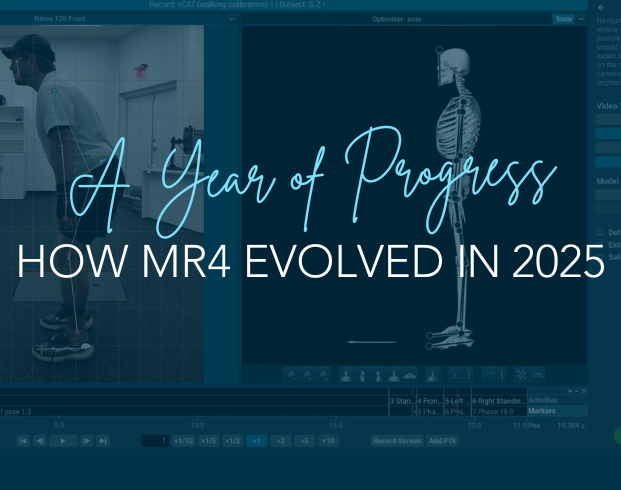
In 2025, MR4 took a decisive step forward. With every release, the platform expanded beyond traditional biomechanics workflows—introducing capabilities that don’t exist in other systems and refining tools that users rely on every day. The result is a software environment built for real movement, long sessions, complex setups, and high-confidence analysis. This recap pulls
The Fall 2025 Release brings major enhancements to calibration flexibility, force-plate analytics, and biofeedback options. This update continues our focus on delivering tools that work in real-world environments, support clinical and performance workflows, and expand the analytical depth of MR4. Below is an overview of what’s new in this release. Download the MR4 Fall
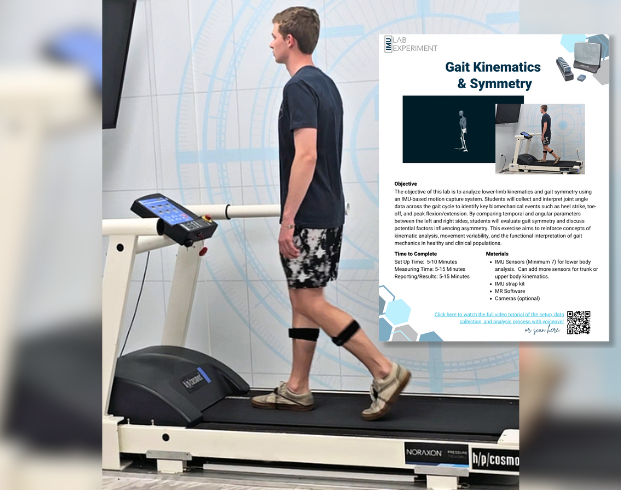
Gait Kinematics and Symmetry In this lab, students will use an IMU-based motion capture system to measure and analyze lower-limb movement throughout the gait cycle. By comparing joint angles and timing between the left and right sides, they will assess gait symmetry and explore the biomechanical factors that influence walking patterns.
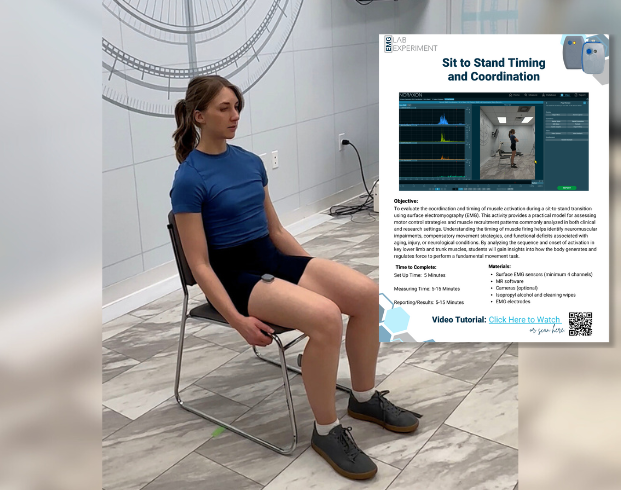
Sit to Stand Timing and Coordination This lab explores the coordination and timing of muscle activation during a sit-to-stand transition using surface EMG. By examining the onset and sequence of activation in key lower limb and trunk muscles, students gain practical insight into motor control strategies, muscle recruitment patterns, and how the body
Blogken